Daily News Roundup: Shocks and Guardrails
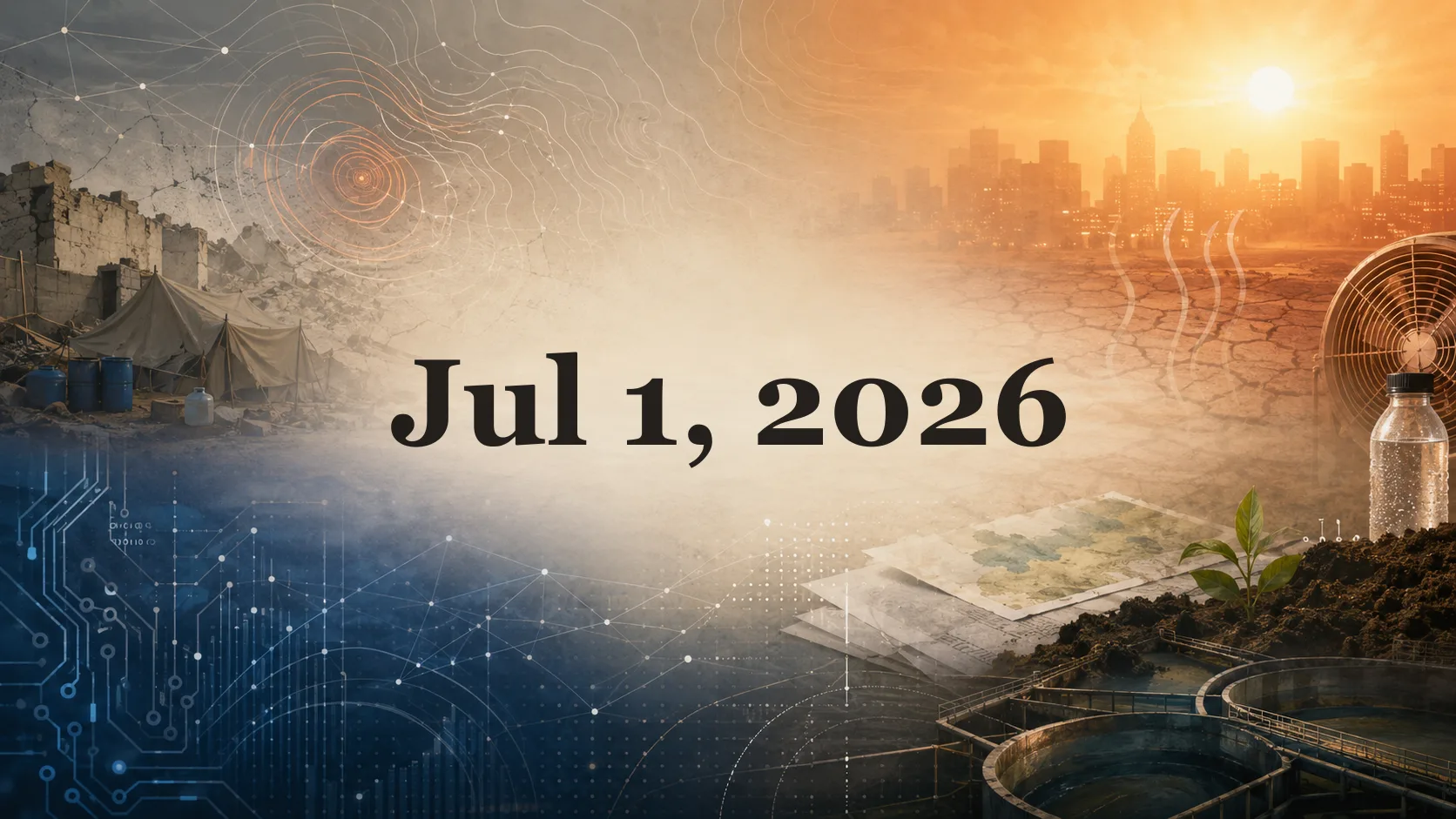
Venezuela faces earthquake-response strain, dangerous U.S. heat collides with July Fourth plans, a UN panel previews AI-governance risks, and EPA opens comment on PFAS biosolids guidance.
A quake response in Venezuela, dangerous U.S. holiday heat, a preliminary UN assessment of AI risk, and EPA draft guidance on PFAS in biosolids all turn on the same public question: how well institutions can respond when the facts are moving and the stakes are immediate.
Venezuela’s quake response tests fragile relief systems
Venezuela is dealing with a humanitarian and public-health crisis after major earthquakes near Yumare. Reported needs include medical care for quake-related injuries, shelter, clean water, and infection prevention.[R1] USGS records show a magnitude 7.2 event near Yumare and PAGER context for a magnitude 7.5 event in the same area.[R2][R3]
The pressure is not only seismic damage. It is what follows: injured people needing treatment, displaced residents needing safe water and shelter, and rescue work moving through strained local systems.[R1] Casualty, missing-person, displacement, and damage figures remain the kind of numbers that can shift quickly after a disaster, so they should be treated as provisional unless tied to a current verified source.[R1]
Holiday heat raises practical safety risks
Extreme heat in the U.S. Northeast is colliding with July Fourth travel, outdoor gatherings, and public celebrations.[R4] That makes the risk wider than personal discomfort. Heat can affect outdoor workers, travelers, event staff, emergency responders, and residents who depend on cooling access.[R4]
Local warning areas and heat-index values can change as forecasts update, so fixed place-by-place numbers need current local sourcing. For now, the clearest point is operational: during a holiday built around movement and outdoor activity, cities and event organizers have to keep transit, utilities, emergency services, and cooling resources matched to conditions as they develop.[R4]
UN AI report sets a governance marker, not a rulebook
The UN independent scientific panel’s preliminary AI assessment describes artificial intelligence as a technology with major potential benefits and systemic risks.[R5] The report is preliminary. It is not binding regulation.[R5]
Its weight comes from the issues it puts on one page: unequal access, concentration of computing power, information-integrity threats, and gaps in regulators’ ability to evaluate fast-moving systems.[R5][R7] The UN Web TV launch page gives official context for the rollout, while The Guardian provides accessible secondary reporting on the inequality and global-capacity concerns.[R6][R7]
This is an institutional story more than a legislative one. The panel gives governments and international bodies a shared reference point for arguments that are often scattered across safety, competition, public trust, and global access.[R5]
EPA opens a PFAS comment process for biosolids
EPA is seeking public comment on draft guidance concerning risk from PFOA and PFOS in biosolids.[R8] The action is draft guidance, not a final rule or mandatory nationwide requirement.[R9]
The affected policy area reaches across wastewater utilities, farmers, landowners, state and Tribal agencies, and communities concerned about exposure.[R9] That is why the issue is not only about chemical management. Biosolids policy sits where wastewater operations, land application, food-system confidence, and public-health risk meet.[R8][R9]
The next step is procedural, but it can still matter. Public comments, state choices, utility practices, and future EPA action will shape how the guidance is used in the real world.[R8][R9]
My view
The thread across these stories is capacity under pressure. A quake exposes whether relief systems can move fast enough. Heat tests whether public events and basic services can adjust before people get sick. AI governance asks whether public institutions can understand a technology that is changing faster than most rulemaking cycles. PFAS guidance shows how even a draft process can affect farmers, utilities, regulators, and communities long before any final mandate appears.
None of these stories is solved by a single announcement. The work is in the handoff from warning to action: medical care, cooling access, technical review, public comment, and implementation. That is where public trust is usually won or lost.
References
Sources
-
Associated Press
-
U.S. Geological Survey
-
U.S. Geological Survey
-
Independent International Scientific Panel on AI
-
Environmental Protection Agency
-
Environmental Protection Agency
Reader comments
Comments