Daily News Roundup: Rules Under Strain
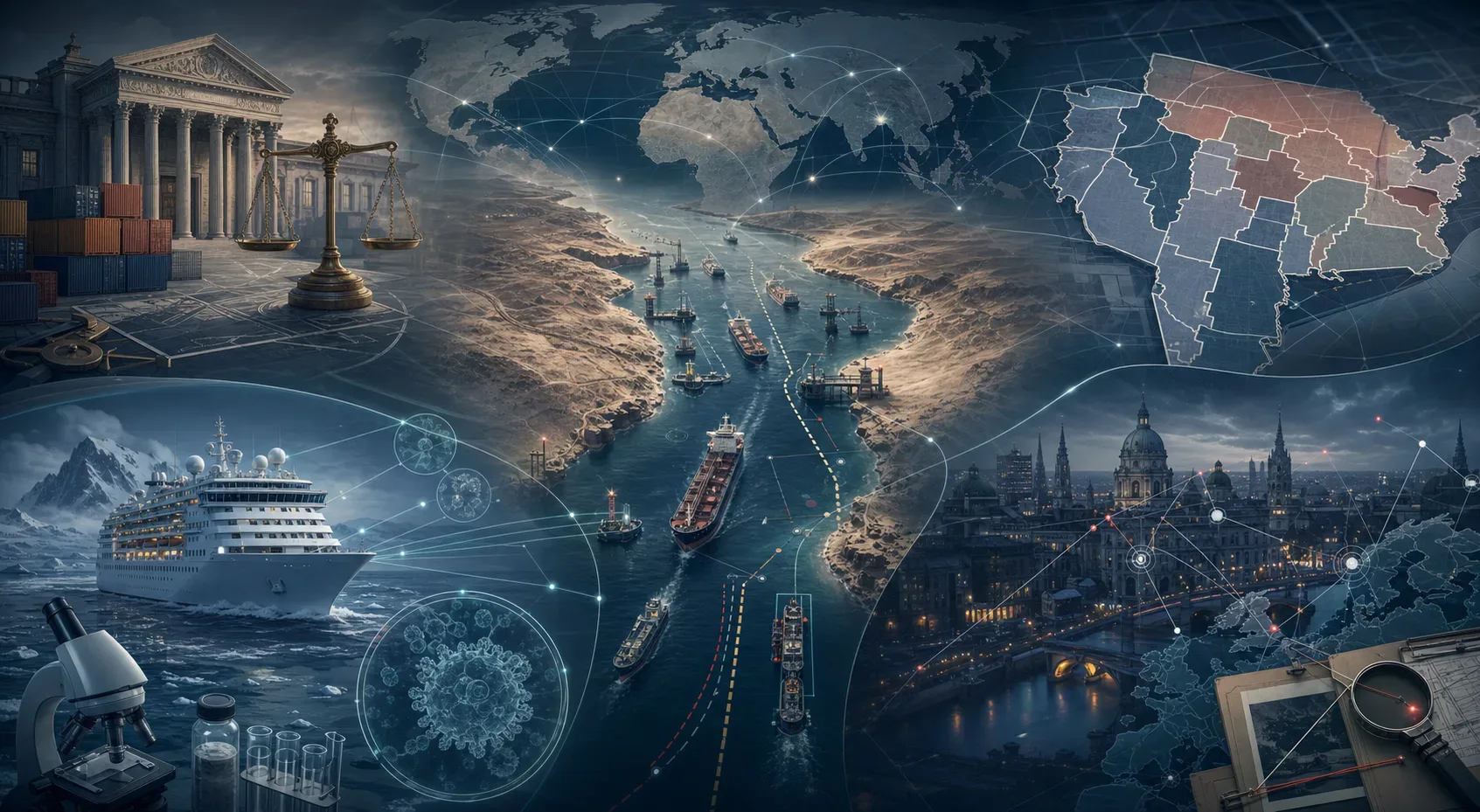
Today’s roundup looks at the Strait of Hormuz, a U.S. tariff ruling, Tennessee redistricting, the MV Hondius hantavirus response, and Russian-linked security pressure in Europe.
Several of the day’s major stories turned on the same practical question: who gets to set the rules when institutions are under pressure?
That question ran through the Strait of Hormuz, U.S. tariff authority, Tennessee’s congressional map, an outbreak response linked to a cruise ship, and European concerns about Russian-linked operations beyond Ukraine’s front line.
Hormuz becomes the day’s central chokepoint
The Iran-U.S. ceasefire process remains active, but attention has shifted to the Strait of Hormuz. AP and Reuters reported that Iran created a mechanism to vet and tax ships seeking passage, while Tehran said it was still reviewing U.S. proposals. Reuters also reported that a U.S.-backed U.N. resolution calling on Iran to stop attacks and mining in the strait faced likely vetoes from China and Russia.
The issue is larger than diplomacy alone. Hormuz is a shipping, energy, insurance, and international-law chokepoint. AP reported that oil prices moved as markets weighed both the chance of a deal and the risk that shipping through the strait could remain constrained.
A late Reuters item cited a Fox News reporter saying U.S. strikes hit Qeshm port and Bandar Abbas. The research notes treated that report as not yet fully confirmed by official or multiple independent sources, so it should be read as a cautious, developing claim rather than a settled fact.
The confirmed story is already significant: a ceasefire can lower the visible temperature of a conflict while leaving the underlying shipping dispute unresolved.
A trade court ruling puts tariff power back in question
Reuters reported that the U.S. Court of International Trade ruled against the administration’s latest 10% global tariff, finding that across-the-board duties were not justified under the 1970s trade law used to impose them. AP separately described the broader trade context, including continued tariff pressure on trading partners such as the European Union.
For importers, manufacturers, retailers, foreign governments, and consumers, the immediate effect is uncertainty. Tariffs can be announced quickly, but the legal tests move more slowly.
The broader question is whether U.S. trade policy is being set mainly by statute, executive action, negotiation, or litigation. That distinction matters because each path creates a different kind of risk for businesses and trading partners trying to plan beyond the next court ruling.
Tennessee’s new House map signals another voting-rights fight
Tennessee enacted a new congressional map that splits the majority-Black district centered on Memphis. Reuters and AP both placed the move in the broader post-Supreme Court environment, where states are reassessing maps after a ruling that weakened Voting Rights Act protections.
Redistricting can sound technical until the lines move. A new map can affect minority representation, the balance of the U.S. House, and the legal fights that continue through an election cycle.
Tennessee now stands as an early example of how quickly a major voting-rights ruling can move from legal doctrine into district boundaries.
The MV Hondius outbreak becomes a coordination test
The hantavirus outbreak linked to the MV Hondius has prompted an international response. WHO reported eight cases, including three deaths, with five confirmed as hantavirus. WHO identified the virus as Andes virus, which can spread between people in limited circumstances involving close and prolonged contact.
AP reported that health authorities across multiple continents were tracing passengers who left the ship before the outbreak was identified. CDC said the risk to the American public was extremely low.
The story is serious, but it is not a signal for broad public panic. It is a reminder that modern travel can turn even a small outbreak into a coordination problem involving international agencies, national health authorities, laboratories, ship operators, and ports.
AP reports wider Russian-linked targeting in Europe
An AP investigation, citing Western intelligence officials, court documents, prosecutors, and targets, reported that Russian-linked assassination plots in Europe have increased since the 2022 invasion of Ukraine. AP described cases involving activists, defectors, Ukraine supporters, and people connected to the defense sector. Russian officials declined or denied responsibility, according to the report.
A related AP story on Poland’s security agency described a broader pattern of Russian hybrid operations, including sabotage networks.
The significance is that Europe’s security burden is not confined to the battlefield in Ukraine. If intimidation, sabotage, surveillance, and targeted violence become recurring tools, the pressure falls on police, courts, intelligence services, civil society, and the political coalitions supporting Ukraine.
My view
The common thread in these stories is not chaos for its own sake. It is rule-setting under strain.
Hormuz shows how a ceasefire can leave the rules of movement unresolved. The tariff ruling shows how executive power can collide with statutory limits. Tennessee’s map shows how quickly a court decision can reshape political representation. The MV Hondius outbreak shows how public-health systems respond when a small incident crosses borders. The AP investigation on Europe shows how security pressure can move into civilian and legal space.
That is why these stories matter together. They are not only about what happened in one strait, one court, one state, one ship, or one region. They show how much depends on whether rules are clear, contested, enforceable, and trusted when the pressure rises.
Reader comments
Comments