Daily News Roundup: Fault Lines and Fallout
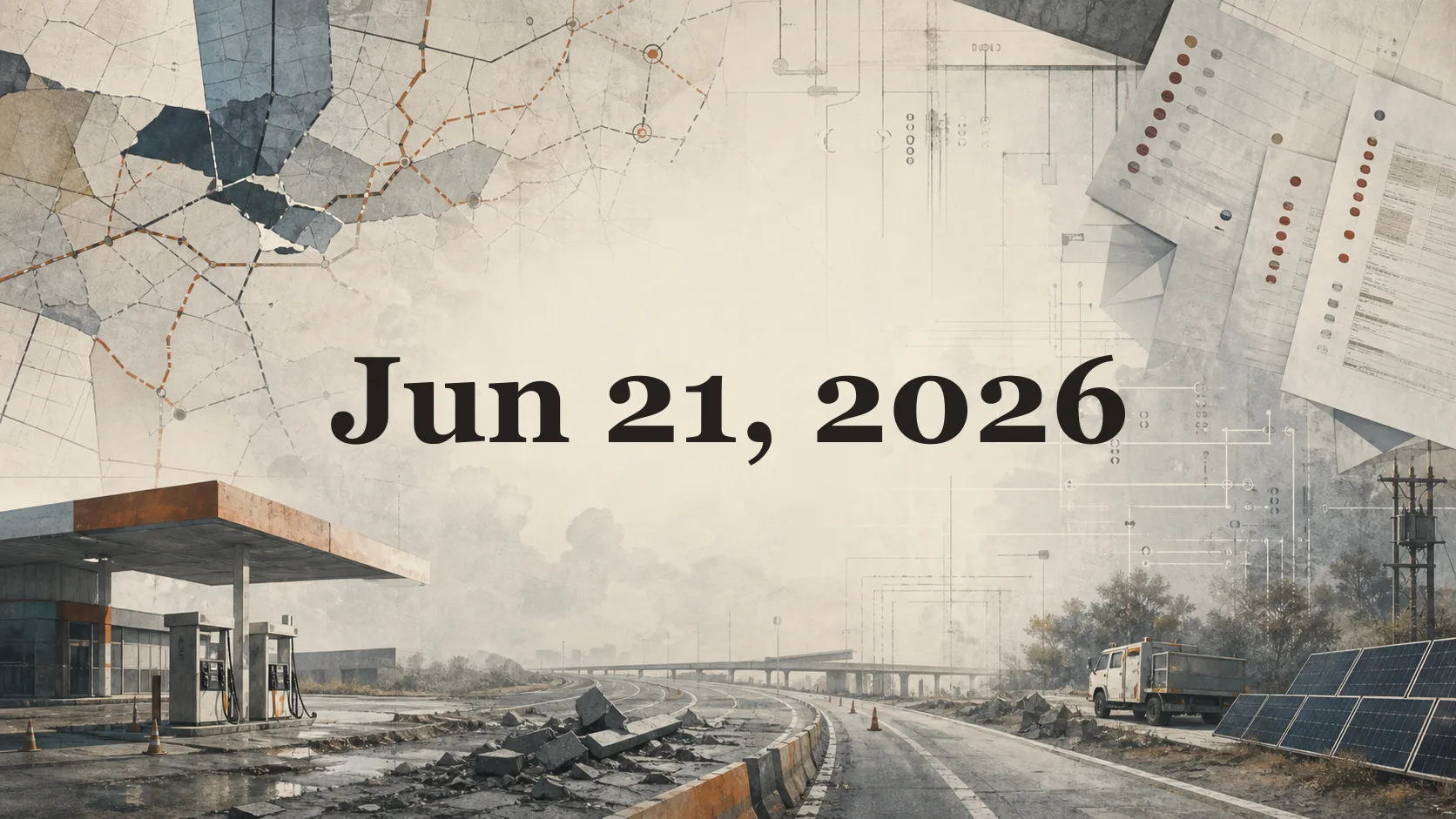
Five developments across conflict, governance, elections, emergency response and public media, framed as of the June 21 package cutoff.
Conditions described below are current as of June 21, 2026.
Fuel cutoff deepens disruption in Crimea
Russian-controlled Crimea halted fuel sales to individuals and non-state businesses after overnight strikes. Russian and Russian-installed officials reported four deaths in Crimea and a separate death at a ferry in Russia’s Krasnodar region. The casualty reports were not independently verified. Officials also reported power and transport disruptions.[R1][R2]
The shutdown turns damage to energy and transport infrastructure into an immediate civilian problem. It also adds pressure to supply routes serving both the peninsula’s population and Russia’s military presence there.[R1][R2]
Bolivia’s blockades ease, but the emergency remains
Bolivia’s legislature approved a nationwide state of emergency after a 50-day blockade crisis. The highway authority issued an early report that no active protest blockades remained, though troops and police were still deployed and damaged roads needed repairs.[R3][R4]
Cleared highways could restore access to food, fuel, medicine, hospitals and markets. Still, the initial road report does not mean the crisis is over. The 90-day emergency leaves open questions about the scope of military authority, the proportionality of the response and whether the de-escalation will hold.[R3][R4]
Ethiopia’s commanding result comes with gaps
Ethiopia’s election board announced that Prime Minister Abiy Ahmed’s Prosperity Party won 438 parliamentary seats, well above the 274 needed for a majority. Voting did not take place in Tigray or parts of Amhara, and other polling locations could not open because of insecurity.[R5][R6]
The seat count gives the ruling party another dominant mandate in parliament. Assessing how fully that result represents the country is harder. Regional exclusions, disrupted voting and limited observer access remain significant constraints. Opposition parties alleged intimidation, allegations the election board denied.[R5][R6]
Los Angeles expands its warehouse-fire response
Los Angeles declared a local emergency on June 20 over the Boyle Heights cold-storage warehouse fire, which began June 17. The declaration was intended to speed access to state and federal resources as crews dealt with hazardous smoke and a difficult industrial cleanup.[R7][R8]
The city identified ammonia off-gassing, hazardous materials, lithium-ion batteries, rooftop solar equipment and decaying food among the risks. Emergency status also broadens the city’s authority to procure equipment, request mutual aid and begin remediation.[R8][R9]
Czech media funding change draws thousands to Prague
Thousands protested in Prague after the Czech government approved replacing broadcaster license fees with direct state-budget financing beginning next year. The new model is expected to reduce funding by roughly 15%. Layoffs are projected, and workers have scheduled a warning strike.[R10][R11]
Critics and media organizations say dependence on annual budget decisions could give future governments leverage over editorial independence. The government rejects that argument and says the financing change does not threaten broadcasters’ independence.[R10][R11]
My view
These stories show how quickly decisions made through war, emergency powers, elections and public budgets reach ordinary life. They determine whether fuel can be bought, roads can be used, ballots can be cast, neighborhoods can breathe safely and broadcasters can plan beyond the next budget cycle.
The details differ, but the useful test is the same: look past the formal announcement and examine who gains authority, who loses access and what remains unresolved after the immediate crisis appears to ease.
References
Sources
-
The Associated Press
-
Paola Flores and Isabel Debre
-
The Associated Press
-
Office of Los Angeles Mayor Karen Bass
Reader comments
Comments