Daily News Roundup: Stress Tests
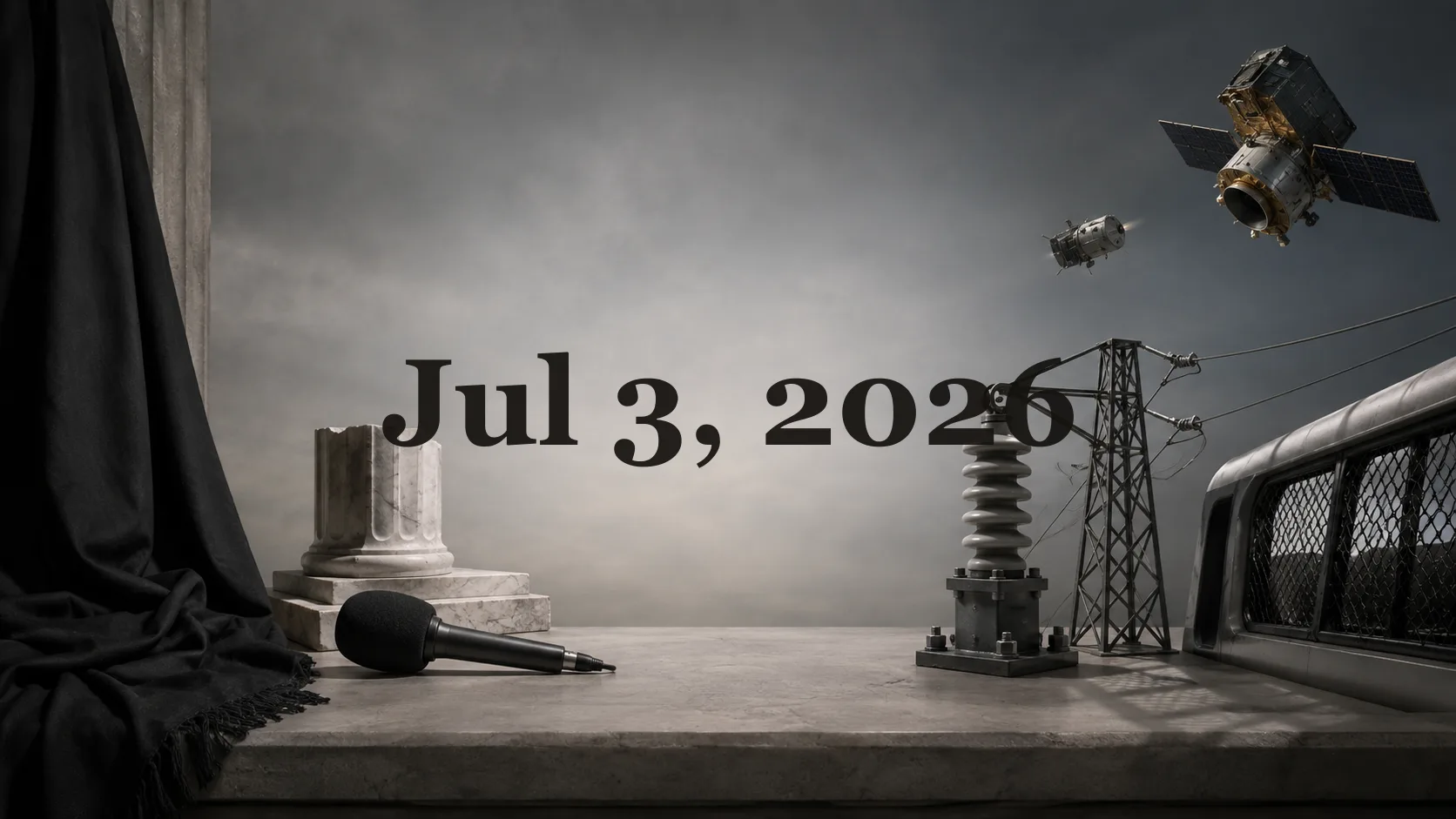
Iran enters a funeral and succession test, the Supreme Court leaves a reporter-source contempt order in place, PJM moves into emergency-prevention mode, NASA-backed satellite servicing launches, and AP/ABC report a late-June ICE arrest surge.
Today's roundup is about systems under pressure: Iran's leadership structure, reporter-source protection in court, the power grid during a heat wave, a NASA observatory in a decaying orbit, and the machinery behind U.S. immigration enforcement.
Iran enters a funeral period with succession unresolved
Iran has begun formal mourning and funeral ceremonies for Ayatollah Ali Khamenei, putting public mobilization, state messaging, and security posture at the center of the country's political moment.[R1][R2]
The available reporting supports a clear point: this is a legitimacy and succession test, not a settled transition.[R1] The stakes reach beyond the funeral ceremonies. Iranian official reaction, regional security concerns, Gulf shipping exposure, and energy-market risk all remain part of the wider backdrop during the mourning period.[R1][R2]
Supreme Court leaves Herridge contempt order in place
The Supreme Court denied Catherine Herridge's emergency request to halt a contempt order tied to source disclosure. The order vacated Chief Justice John Roberts' temporary hold and noted that Justice Brett Kavanaugh would have granted the stay.[R3]
That ruling is procedural. It does not decide the merits of the underlying Privacy Act litigation.[R3][R4] Still, the immediate effect is practical pressure: AP reported the contempt dispute and the $800-a-day fine, while the Reporters Committee material places the case in the broader fight over reporter's privilege and source confidentiality.[R4][R5]
PJM's heat story becomes a grid-action story
This is a continued event follow-up to the July 1 heat coverage. The new development is not simply hotter weather. PJM has taken official grid actions, including hot-weather operations, emergency-preparedness measures, demand-response activation, and operating alerts across its footprint.[R6][R7]
The evidence supports tight operating conditions and emergency prevention, not confirmed widespread outages. PJM's update and emergency dashboard point to load-management posture and operational alerts observed during the workflow check period; they do not support a claim of large-scale rolling blackouts.[R6][R7]
NASA-backed mission launches to boost Swift
A NASA-backed Katalyst Space Technologies mission launched from the Marshall Islands to attempt an orbital boost of NASA's Neil Gehrels Swift Observatory.[R8][R9]
NASA says Swift's orbit has been decaying because of increased atmospheric drag, making the mission a test of commercial robotic servicing for an operating science observatory.[R8] AP and Space.com support the rescue-mission framing, but the checked sources support only the launch and planned attempt. They do not report that Swift has already been saved.[R9][R10]
AP and ABC report late-June ICE arrest surge
AP and ABC reported that ICE arrested 10,000 people over a five-day period at the end of June.[R11][R12] DHS materials support contemporaneous administration messaging around immigration enforcement, but they do not provide a full public audit of the reported arrest total.[R13]
That distinction matters. The reported scale puts pressure on detention capacity, immigration courts, local communities, civil-liberties disputes, and federal-state enforcement tensions.[R11] The checked public sources do not resolve the full geography, case mix, detention status, or criminal-charge breakdown behind the figure, so the count should remain attributed to AP and ABC rather than treated as an independently verified public dataset.[R11][R12]
My view
The common thread is strain before resolution.
Iran's funeral period shows how much uncertainty can sit inside formal ceremony. The Herridge order shows how a short procedural ruling can still carry immediate consequences for source protection. PJM's alerts show that infrastructure risk often appears first as prevention work, not visible failure. Swift's rescue launch shows a different kind of stress test: whether commercial servicing can extend the life of a public science asset. The ICE arrest reports show how quickly enforcement scale can outpace the public detail needed to understand what happened.
The useful signal is not collapse. It is capacity under load. These stories matter because they show where institutions are being asked to absorb pressure before the final outcome is clear.
References
Sources
-
Nasser Karimi and Jon Gambrell
-
Supreme Court of the United States
-
Lindsay Whitehurst and Eric Tucker
-
Reporters Committee for Freedom of the Press
-
U.S. Department of Homeland Security
Reader comments
Comments